
Gross Margin vs Net Margin: Key Differences, Formulas, and Examples
A business can generate impressive sales and still struggle to make money. That is why understanding gross vs net margin matters for business owners, entrepreneurs, and financial managers. Although both metrics measure profitability, they reveal different aspects of a company’s financial performance.
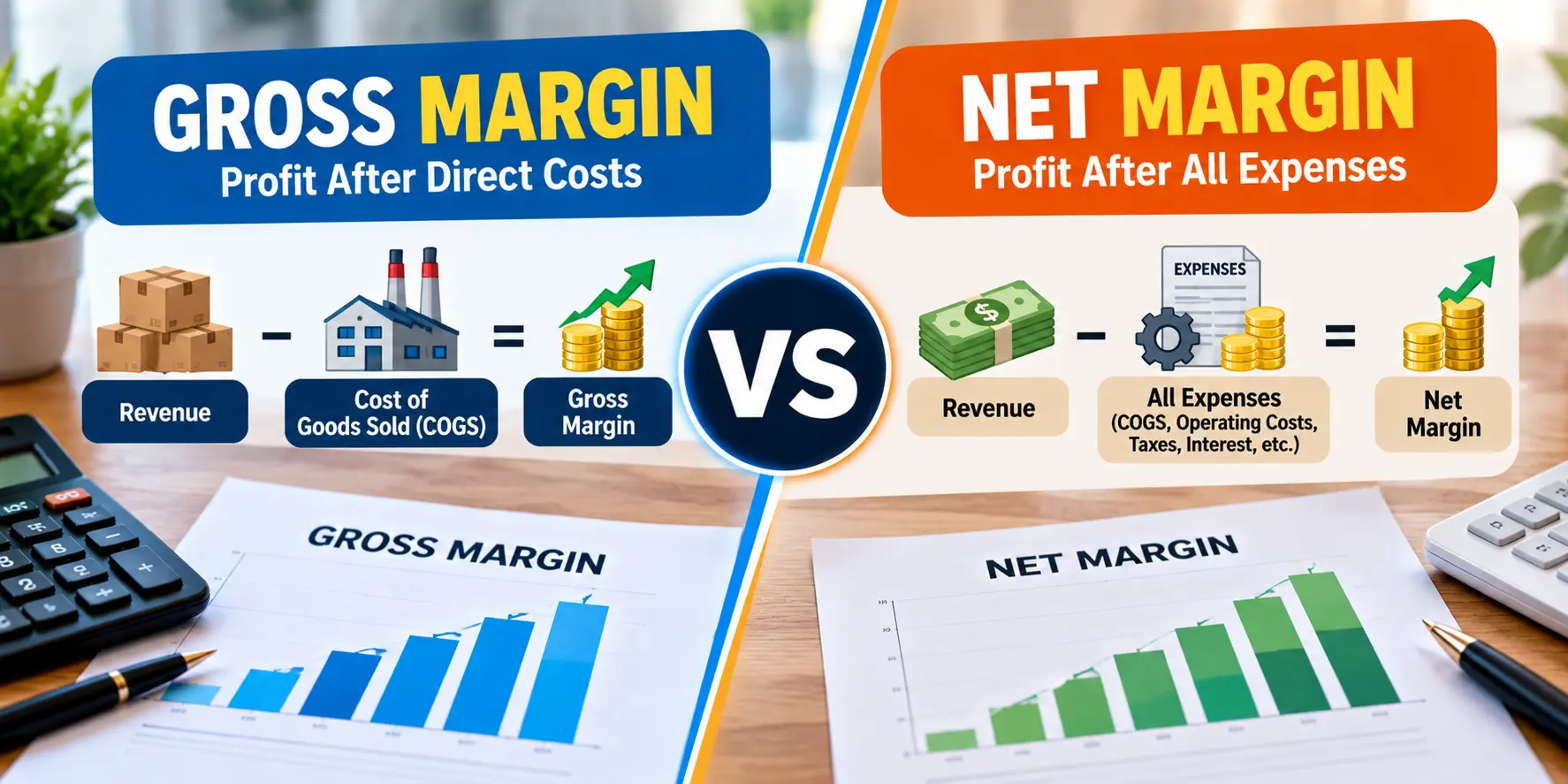
Gross margin shows how much revenue remains after paying the direct costs of producing goods or delivering services. In contrast, net margin measures how much revenue becomes profit after accounting for operating expenses, interest, taxes, and other items included in net income.
For example, a company might report a 60% gross margin but only a 12% net margin. This difference shows how additional expenses affect overall profitability. Therefore, understanding both metrics helps businesses improve pricing, control costs, and make better financial decisions.
Gross vs Net Margin: Main Differences
The main difference between gross and net margin is the number of expenses included in each calculation. Gross margin focuses on revenue remaining after the cost of goods sold (COGS), while net margin considers the company’s final profit after recognized income and expenses.
| Feature | Gross Margin | Net Margin |
|---|---|---|
| Meaning | Profitability after direct production costs | Overall business profitability |
| Calculation | Gross profit ÷ Revenue × 100 | Net income ÷ Revenue × 100 |
| Expenses included | Cost of goods sold | Expenses included in net income |
| Main purpose | Evaluate production and service efficiency | Evaluate overall profitability |
| Financial statement | Based on gross profit | Based on net income |
| Typical use | Pricing and cost analysis | Financial planning and performance |
Both metrics are expressed as percentages. However, each answers a different financial question.
Gross margin asks how efficiently a business produces or delivers what it sells. Meanwhile, net margin reveals how much of its revenue the company ultimately keeps as profit.
Therefore, comparing both metrics provides a more complete picture than examining either one alone.
Gross vs Net Margin: Gross Margin Formula and Calculation
Gross profit margin measures the percentage of revenue remaining after subtracting the direct costs associated with producing goods or providing services.
These costs generally include materials, direct production labor, and certain manufacturing expenses. For example, a furniture manufacturer may pay for wood, production workers, and factory-related production costs.
After subtracting these expenses from sales revenue, the remaining amount is gross profit.
Gross vs Net Margin: Gross Margin Formula
The formula for gross margin is:
Gross Margin = (Revenue − Cost of Goods Sold) ÷ Revenue × 100
Suppose a company reports the following figures:
- Total revenue: $200,000
- Cost of goods sold: $80,000
- Gross profit: $120,000
The calculation becomes:
Gross Margin = ($120,000 ÷ $200,000) × 100
Gross Margin = 60%
This means the business retains $0.60 from every dollar of revenue after covering its cost of goods sold. However, it must still pay other business expenses before determining net income.
Why Gross Margin Matters in Gross vs Net Margin Analysis
A strong gross margin can indicate efficient production, favorable supplier pricing, or effective product pricing. For example, retailers often monitor gross margins when evaluating individual products.
However, gross margin differs from markup. Understanding margin vs markup helps business owners avoid pricing mistakes because these calculations use different denominators.
In addition, tracking gross margin over time can reveal rising production costs or changes in product profitability.
Gross vs Net Margin: Net Margin Formula and Calculation
Net profit margin measures the percentage of revenue remaining as net income after accounting for all income and expenses recognized in the income statement.
Unlike gross margin, this metric reflects broader financial performance. For instance, a business may generate substantial gross profit but spend heavily on advertising, administration, loan interest, and taxes. Consequently, its net margin may be much smaller.
Gross vs Net Margin: Net Margin Formula
The formula for net margin is:
Net Margin = Net Income ÷ Revenue × 100
Suppose a business reports these figures:
- Total revenue: $200,000
- Total expenses: $176,000
- Net income: $24,000
The calculation becomes:
Net Margin = ($24,000 ÷ $200,000) × 100
Net Margin = 12%
Therefore, the business earns $0.12 in net profit for every dollar of revenue.
For a better understanding of how businesses report revenue, expenses, and earnings, read the SEC’s Beginners’ Guide to Financial Statements.
Why Net Margin Matters in Gross vs Net Margin Analysis
Net margin provides a broader picture of business profitability. For example, investors use it to evaluate financial performance, while business owners use it to monitor spending and earnings.
However, a positive net margin does not automatically mean a company has strong cash flow. Businesses must also monitor payment collection, working capital, and debt obligations.
For a better understanding of how businesses report revenue, expenses, and earnings, review the SEC’s Beginners’ Guide to Financial Statements.
Gross vs Net Margin: Step-by-Step Calculation Example
Consider a small online clothing business with annual revenue of $500,000. Its financial performance looks like this:
| Financial Item | Amount |
|---|---|
| Sales revenue | $500,000 |
| Cost of goods sold | $200,000 |
| Gross profit | $300,000 |
| Operating expenses | $180,000 |
| Interest expense | $10,000 |
| Income tax expense | $22,000 |
| Net income | $88,000 |
Step 1: Calculate Gross Margin
First, divide gross profit by total revenue.
Gross Margin = ($300,000 ÷ $500,000) × 100
Gross Margin = 60%
Therefore, the company retains 60% of its revenue after covering direct product costs.
Step 2: Calculate Net Margin
Next, divide net income by total revenue.
Net Margin = ($88,000 ÷ $500,000) × 100
Net Margin = 17.6%
Although the business earns a strong gross margin, operating expenses and other costs reduce its final profitability.
This example demonstrates why comparing both margins gives managers a clearer understanding of financial performance.
Gross vs Net Margin: Which Is More Important?
Neither metric is universally more important. Instead, the best choice depends on the financial question being asked.
Gross margin is particularly useful when evaluating product pricing, production costs, and supplier efficiency. For example, a manufacturer experiencing rising material costs may notice declining gross margins before seeing major changes in net income.
Meanwhile, net margin is more useful for evaluating overall profitability and business sustainability.
Companies should also understand types of expenses because cost classification affects financial reporting and profitability analysis.
Therefore, reviewing both metrics together provides better insight than relying on either one alone.
Factors That Affect Gross vs Net Margin
Several business decisions influence profitability. However, some factors affect gross margin more directly than net margin.
Production Costs and Gross Margin
Higher material prices or manufacturing expenses generally reduce gross margin when selling prices remain unchanged.
For example, a bakery facing rising flour prices may experience lower gross profitability. Consequently, negotiating supplier contracts or reducing production waste can help protect margins.
Pricing Strategy and Profit Margins
Increasing selling prices may improve both margins if sales volume and costs remain relatively stable. However, excessive price increases can reduce customer demand.
Therefore, businesses should consider competitors, customer expectations, and product value before adjusting prices.
Operating Expenses and Net Margin
Rent, administrative salaries, marketing, and office expenses typically affect net margin rather than gross margin.
For instance, a company may maintain strong gross profitability while experiencing declining net income because advertising costs increase. Consequently, managers should monitor operating expenses alongside production costs.
Interest, Taxes, and Net Profit Margin
Interest expenses and income taxes also influence net profitability. As a result, businesses with similar gross margins may report different net margins because of financing arrangements or tax circumstances.
However, these differences do not necessarily indicate that one company operates more efficiently than another.
Gross vs Net Margin Across Different Industries
Profit margins vary significantly between industries because businesses operate with different cost structures.
For example, software companies may have relatively low direct delivery costs, while grocery retailers often operate with narrower product margins. Similarly, manufacturing businesses may face substantial material, labor, and equipment-related production expenses.
Consequently, comparing a software company’s gross margin with a supermarket’s gross margin may provide limited insight.
Instead, businesses should compare profitability with similar companies using consistent accounting methods. Discussions about the most profitable businesses should also consider industry differences, business models, operating costs, and capital requirements rather than focusing on a single margin percentage.
How to Improve Gross Profit Margins
Improving gross margin requires attention to pricing, production efficiency, and direct costs. Businesses can start by identifying the products and processes that have the greatest effect on profitability.
Review Product Pricing
First, identify products with weak gross margins. Then, determine whether selling prices adequately reflect production costs and customer value.
However, avoid increasing prices without considering market demand and competitor pricing.
Reduce Production Waste
Next, examine material usage, damaged inventory, and inefficient production processes.
For example, manufacturers can improve margins by reducing defective products and unnecessary material consumption. As a result, businesses may lower direct production costs without sacrificing product quality.
Negotiate Supplier Agreements
Better purchasing terms may lower the cost of goods sold. Businesses can compare suppliers, negotiate appropriate volume discounts, or improve purchasing schedules.
Nevertheless, lower prices should not come at the expense of product quality or reliable delivery.
Improve Product Mix
Some products generate stronger gross margins than others. Therefore, businesses can evaluate which products contribute the most gross profit while also considering customer demand and sales volume.
For example, promoting a higher-margin product may improve overall profitability if customers continue purchasing at a sustainable rate.
How to Improve Net Profit Margins
Improving net margin requires a broader approach because the calculation includes expenses beyond direct production costs. Businesses should examine operating costs, marketing performance, and financial planning.
Control Operating Costs
Start by reviewing recurring expenses, including software subscriptions, administrative spending, and office costs. Then, eliminate unnecessary spending without reducing essential business capabilities.
For example, consolidating overlapping software subscriptions may lower expenses without disrupting daily operations.
Measure Marketing Performance
Marketing can increase revenue, but ineffective campaigns may reduce net profitability.
Therefore, businesses should monitor customer acquisition costs, conversion rates, and the profitability of different sales channels. In addition, reviewing campaign performance can help managers direct spending toward more effective activities.
Improve Financial Planning
Accurate budgeting helps companies anticipate expenses and avoid unnecessary financial pressure.
Understanding the difference between finance and accounting also helps managers separate financial recordkeeping from decisions about funding, investment, and future business performance.
As a result, managers can make better-informed decisions about spending and growth.
Monitor Profitability Regularly
Finally, review financial statements monthly or quarterly. Compare margins with previous periods and investigate unexpected changes.
This approach helps managers identify problems before they become serious.
Gross vs Net Margin: Common Mistakes
Business owners sometimes misunderstand profitability metrics, especially when comparing gross profit margin with net profit margin.
One common mistake is assuming high gross margins guarantee strong overall profits. However, excessive operating expenses can quickly reduce net income.
Another mistake is comparing businesses from unrelated industries without considering their cost structures. Similarly, companies may calculate margins incorrectly by using gross profit instead of net income in the net margin formula.
Businesses should also avoid confusing revenue growth with profitability growth. For example, sales may increase while net margin declines because operating expenses grow faster than revenue.
Therefore, accurate calculations and consistent financial reporting are essential.
Frequently Asked Questions About Gross vs Net Margin
Is Gross Margin Always Higher Than Net Margin?
Gross margin is usually higher because net income generally reflects more expenses. However, unusual gains, tax benefits, or other accounting items can occasionally produce different results.
What Is a Good Gross Margin?
A good gross margin depends on the industry, business model, and competitive environment. Therefore, businesses should compare their results with relevant industry benchmarks and historical performance.
What Is a Good Net Profit Margin?
There is no universal target for a good net margin. Instead, companies should evaluate their results against comparable businesses, operating risks, and long-term financial goals.
Can a Business Have a Positive Gross Margin but Negative Net Margin?
Yes. For example, a company may earn gross profit from sales but report a net loss because operating expenses, interest, and other costs exceed that profit.
Does Gross Margin Include Employee Salaries?
Gross margin includes labor costs classified within the cost of goods sold, such as direct production labor. However, administrative salaries generally appear in operating expenses.
Why Is Net Margin Lower Than Gross Margin?
Net margin is generally lower because it reflects operating expenses, financing costs, taxes, and other income statement items beyond the cost of goods sold.
Using Gross vs Net Margin for Business Decisions
Understanding gross vs net margin helps business owners evaluate profitability from two different perspectives.
Gross margin reveals how efficiently a company produces goods or delivers services. Meanwhile, net margin shows how much revenue remains after accounting for the business’s overall income and expenses.
For better financial management, track both metrics consistently, compare results with relevant industry benchmarks, and investigate significant changes.
Most importantly, use profitability data to guide practical decisions about pricing, cost control, marketing, and long-term business growth.